
Getting around
Metro
Próxima paragem.
Next stop.
You hear this when the doors close or the next stop is called. It is written down too, so a missed word does not end the ride.
Portugal
Lisbon stacks tiled lanes and lookouts over the Tagus, the river its ships once left by.
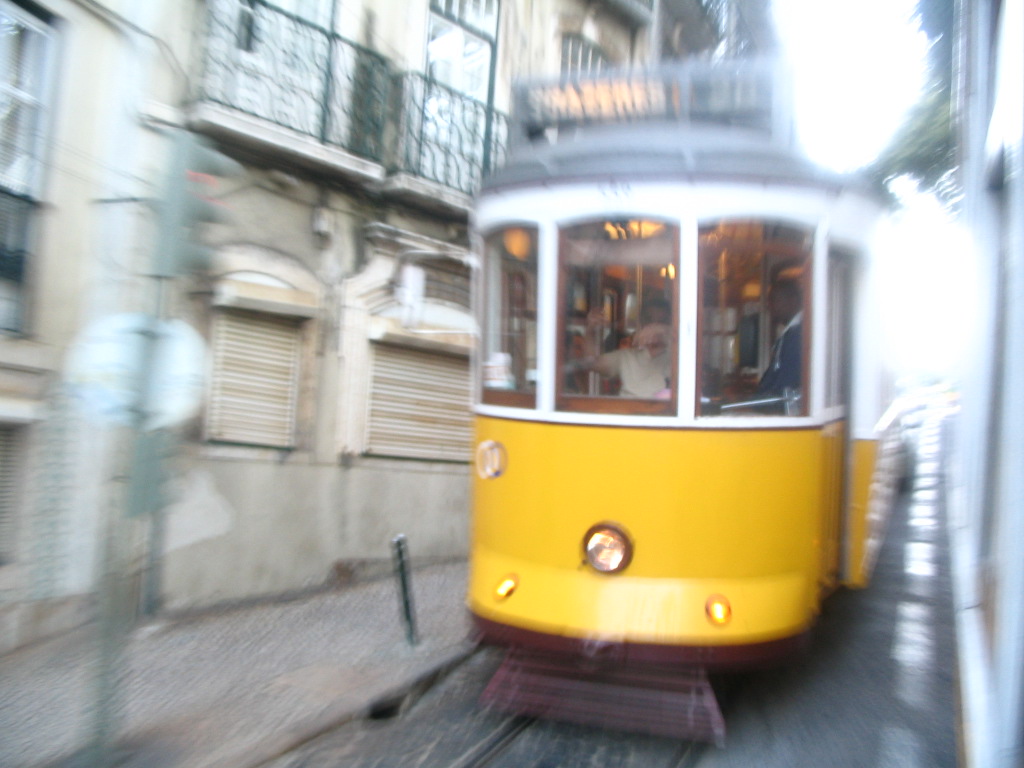
Portuguese is official on shop signs, the metro, and in fado houses, with a European sound unlike Brazil.
Ordinary lines from this city: the ride, the counter, the food, and the greeting.
Getting around
Metro
Próxima paragem.
Next stop.
You hear this when the doors close or the next stop is called. It is written down too, so a missed word does not end the ride.
Food
Pastelaria
Um pastel de nata, se faz favor.
A custard tart.
The order is built in short pieces like this one.
The counter
Eléctrico
Sai na próxima.
Getting off.
This line is a whole order. You do not need a longer sentence.
The street
Rua
Bom dia.
Good morning.
People keep this line short. It is enough for the moment.
This is European Portuguese, more closed than Brazilian speech. You hear it on the metro and at the counter.
Around Alfama, Bairro Alto, Mouraria, this is the ordinary sound of the day.
A first day in Lisbon can run on four lines: “Próxima paragem.”, “Um pastel de nata, se faz favor.”, “Sai na próxima.”, and “Bom dia.”. Each one is already a complete moment.
One local word: Pastel de nata. It means A custard tart..
Bakeries sell pastel de nata, and tascas serve grilled sardines and bacalhau.
Trams and the metro climb the hills, and ferries cross the Tagus. Stops are in Portuguese.
You read Portuguese on menus and neighbourhood signs, and a café order stays short.
| Phrase | Meaning |
|---|---|
| Olá | Hello |
| Obrigado | Thank you |
| Bom dia | Good morning |
| Chamo-me… | My name is… |

Choose the language you want to learn. Start in the browser or in the mobile app.
Start learning for freeA shared scale for language level, from beginner to advanced.
CEFR is the Common European Framework of Reference for Languages. A1 and A2 are beginner, B1 and B2 are intermediate, and C1 and C2 are advanced. You choose the level that matches what you already know.