
Getting around
Метро
Осторожно, двери закрываются.
The doors are closing.
You hear this when the doors close or the next stop is called. It is written down too, so a missed word does not end the ride.
Belarus
Minsk is a rebuilt capital of broad avenues, a river, and a skyline set after the old town was lost.
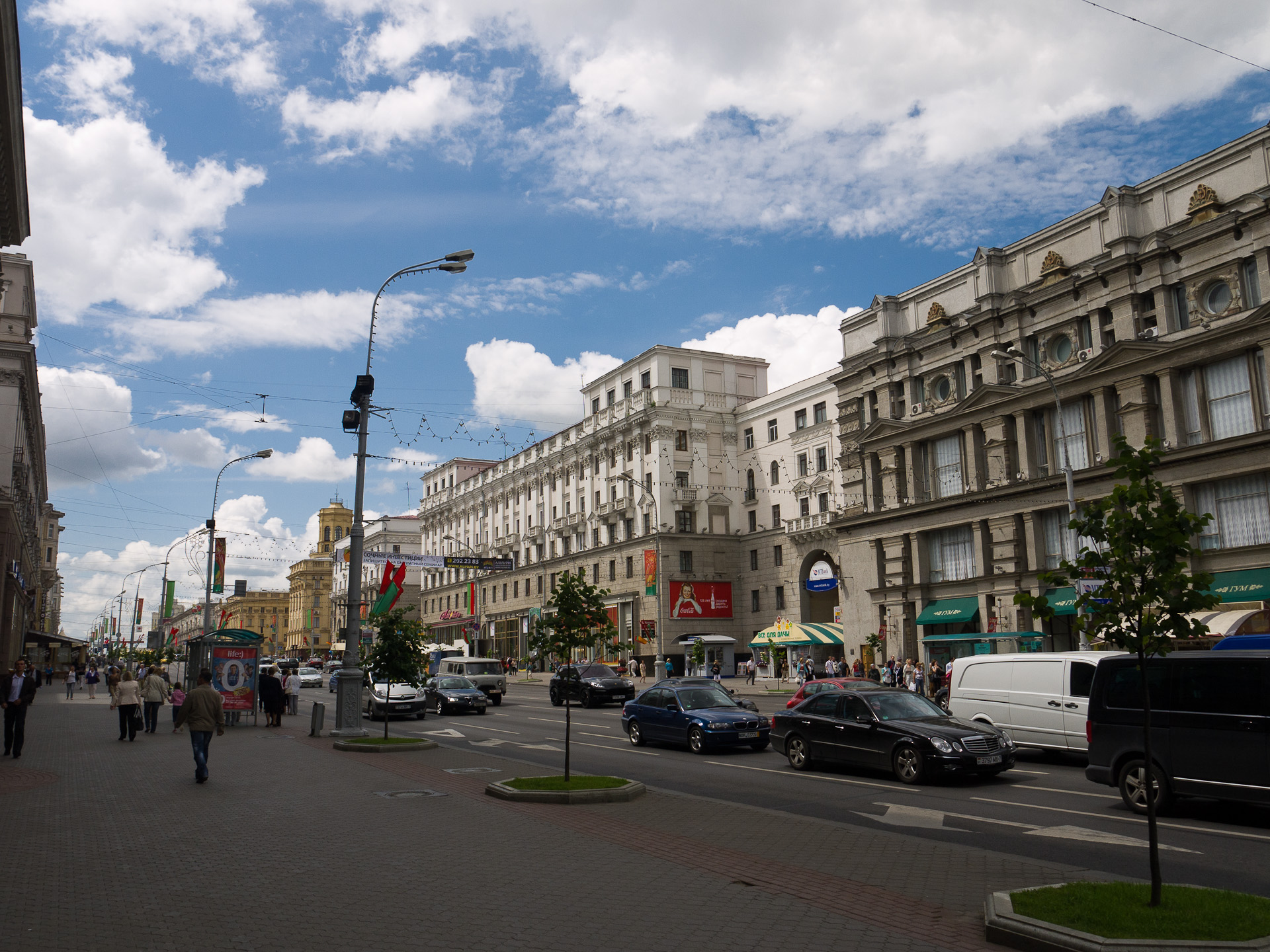
Russian and Belarusian are both official. In the city, Russian is the one you hear more in shops and on the street.
Ordinary lines from this city: the ride, the counter, the food, and the greeting.
Getting around
Метро
Осторожно, двери закрываются.
The doors are closing.
You hear this when the doors close or the next stop is called. It is written down too, so a missed word does not end the ride.
The counter
Кафе
Адзін кавы, калі ласка.
One coffee, please.
This line is a whole order. You do not need a longer sentence.
Food
Крама
Здравствуйте.
Hello.
The order is built in short pieces like this one.
The street
Вуліца
Дзякуй.
Thank you.
People keep this line short. It is enough for the moment.
Russian and Belarusian are both official. On the street you hear Russian more often.
Around Independence Avenue, Nemiga, Trajeckaje, this is the ordinary sound of the day.
A first day in Minsk can run on four lines: “Осторожно, двери закрываются.”, “Адзін кавы, калі ласка.”, “Здравствуйте.”, and “Дзякуй.”. Each one is already a complete moment.
One local word: Дзякуй. It means Thank you..
Draniki potato pancakes, machanka, and kolduny. The names are Belarusian even on a Russian menu.
A metro runs under very wide avenues. Stop names may appear in Russian.
You will mostly hear Russian. Belarusian still shows up on official titles and some signs.
| Phrase | Reading | Meaning |
|---|---|---|
| Здравствуйте | Zdravstvuyte | Hello |
| Спасибо | Spasibo | Thank you |
| Доброе утро | Dobroye utro | Good morning |
| Меня зовут… | Menya zovut… | My name is… |

Choose the language you want to learn. Start in the browser or in the mobile app.
Start learning for freeA shared scale for language level, from beginner to advanced.
CEFR is the Common European Framework of Reference for Languages. A1 and A2 are beginner, B1 and B2 are intermediate, and C1 and C2 are advanced. You choose the level that matches what you already know.