
Getting around
地铁
请站稳扶好。
Hold on and stand firm.
You hear this when the doors close or the next stop is called. It is written down too, so a missed word does not end the ride.
Mandarin is the public language. Sichuanese is common in everyday talk.
Ordinary lines from this city: the ride, the counter, the food, and the greeting.
Getting around
地铁
请站稳扶好。
Hold on and stand firm.
You hear this when the doors close or the next stop is called. It is written down too, so a missed word does not end the ride.
Food
馆子
来一份麻婆豆腐。
A plate of mapo tofu.
The order is built in short pieces like this one.
The counter
茶馆
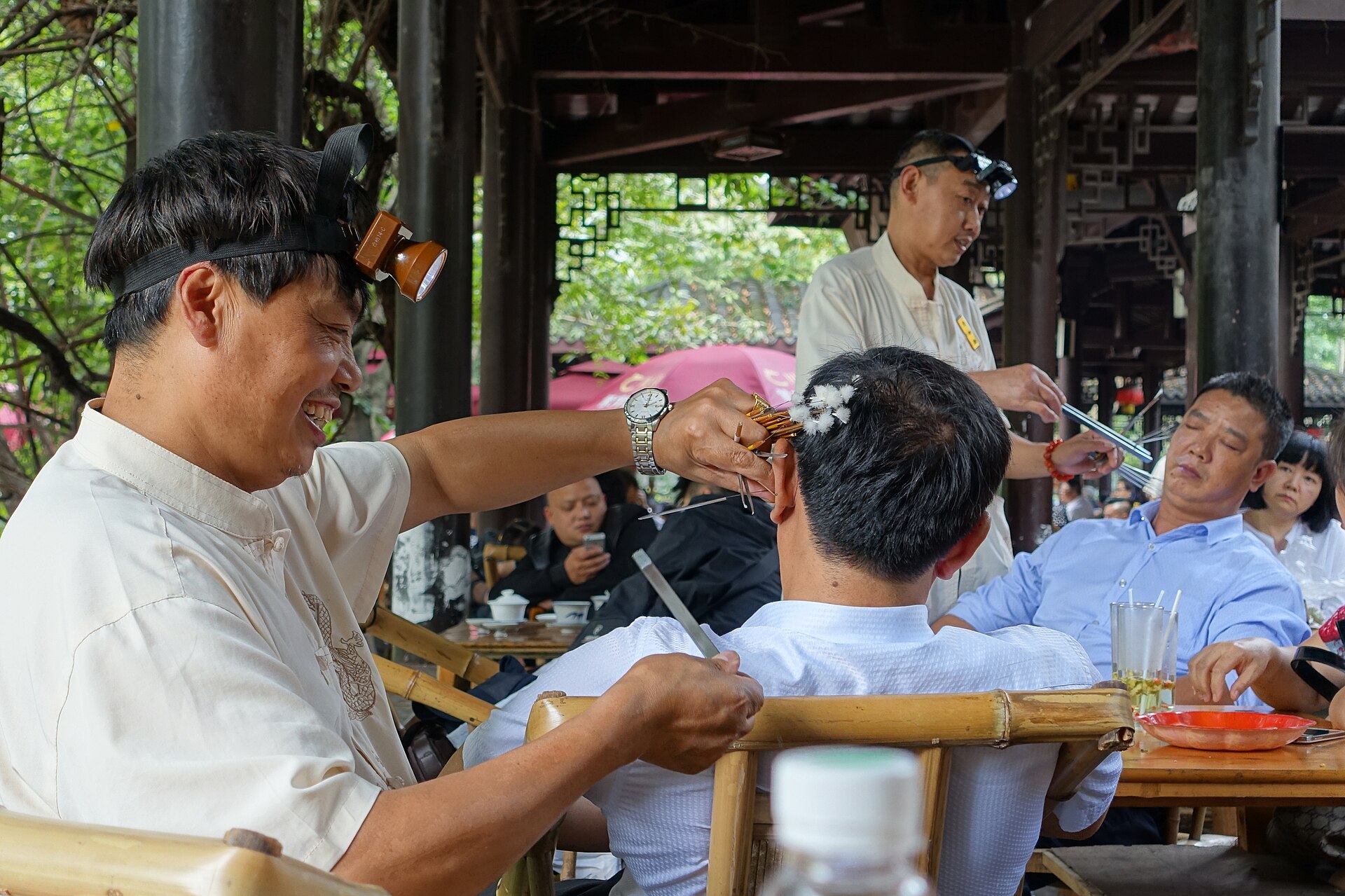
喝茶。
Let's have tea.
This line is a whole order. You do not need a longer sentence.
The street
街
要得。
All right.
People keep this line short. It is enough for the moment.
Announcements and schools use Chinese. At home and in the market around Jinli, Kuanzhai, Chunxi, you still hear Sichuanese.
Around Jinli, Kuanzhai, Chunxi, this is the ordinary sound of the day.
A first day in Chengdu can run on four lines: “请站稳扶好。”, “来一份麻婆豆腐。”, “喝茶。”, and “要得。”. Each one is already a complete moment.
One local word: 要得. It means All right..
Sichuan cooking is hot and fragrant. You order in Mandarin, and you may hear dialect around you.
The metro and buses cover the plain. Announcements use Mandarin, and you listen for your stop.
You ask for a dish with chilli or without it, in Mandarin.
| Phrase | Reading | Meaning |
|---|---|---|
| 你好 | Nǐ hǎo | Hello |
| 谢谢 | Xièxie | Thank you |
| 早上好 | Zǎoshang hǎo | Good morning |
| 我叫… | Wǒ jiào… | My name is… |

Choose the language you want to learn. Start in the browser or in the mobile app.
Start learning for freeA shared scale for language level, from beginner to advanced.
CEFR is the Common European Framework of Reference for Languages. A1 and A2 are beginner, B1 and B2 are intermediate, and C1 and C2 are advanced. You choose the level that matches what you already know.