
Getting around
S-Bahn
Zurückbleiben, bitte.
Stand back, please.
You hear this when the doors close or the next stop is called. It is written down too, so a missed word does not end the ride.
Germany
Frankfurt am Main is a riverside business city, with a small rebuilt old town under the bank towers.
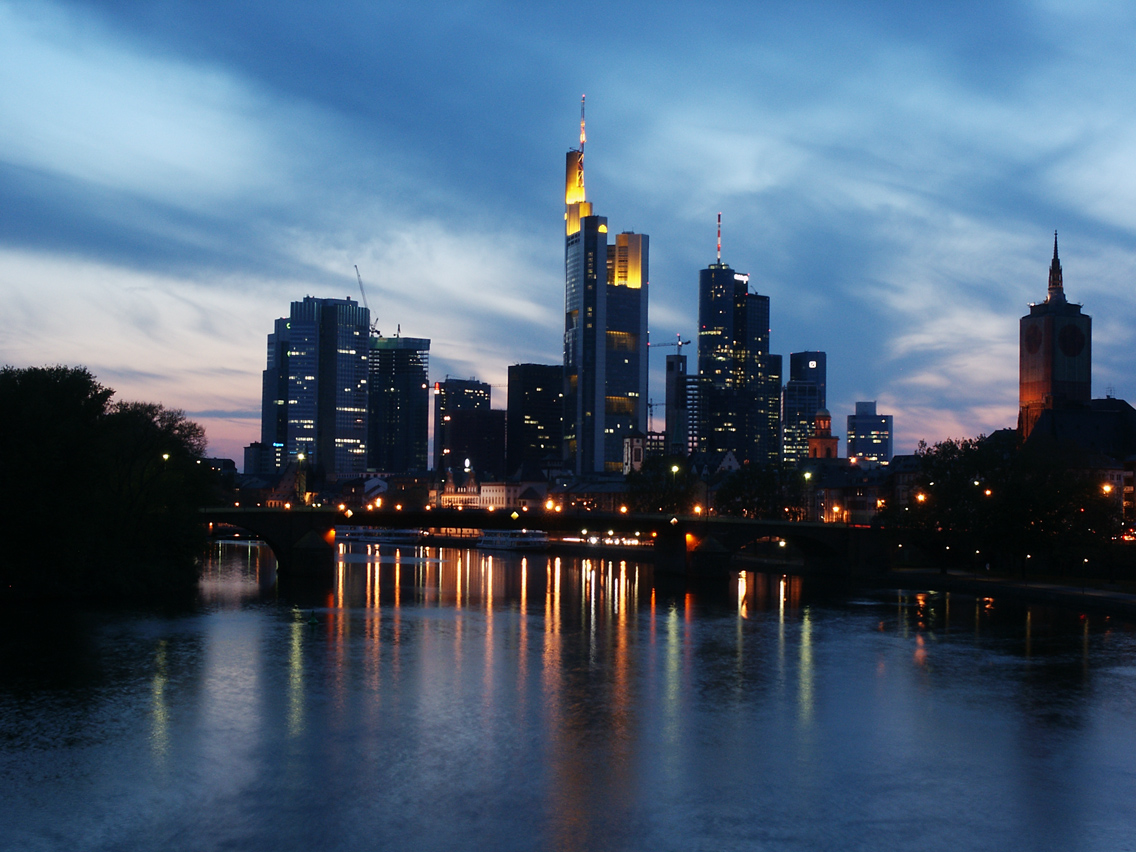
German runs the streets and the offices, and English shows up in international business without replacing everyday German.
Ordinary lines from this city: the ride, the counter, the food, and the greeting.
Getting around
S-Bahn
Zurückbleiben, bitte.
Stand back, please.
You hear this when the doors close or the next stop is called. It is written down too, so a missed word does not end the ride.
Food
Sachsenhausen
Ein Schoppen, bitte.
A glass of apple wine.
The order is built in short pieces like this one.
The counter
Büro
Guten Tag.
Good day.
This line is a whole order. You do not need a longer sentence.
The street
Bäckerei
Ein Brötchen, bitte.
One bread roll, please.
People keep this line short. It is enough for the moment.
German is the language of the ride, the shop, and the street.
In Sachsenhausen, Bornheim, Bahnhofsviertel, you also hear English.
A first day in Frankfurt can run on four lines: “Zurückbleiben, bitte.”, “Ein Schoppen, bitte.”, “Guten Tag.”, and “Ein Brötchen, bitte.”. Each one is already a complete moment.
One local word: Schoppen. It means A glass of apple wine..
Green sauce and cider taverns are local, and the Kleinmarkthalle sells cheese and produce.
U-Bahn, S-Bahn, and trams run under the bank towers and out toward the airport.
You pass the bank towers in the morning and the river promenade once the offices empty.
| Phrase | Meaning |
|---|---|
| Hallo | Hello |
| Danke | Thank you |
| Guten Morgen | Good morning |
| Ich heiße… | My name is… |

Choose the language you want to learn. Start in the browser or in the mobile app.
Start learning for freeA shared scale for language level, from beginner to advanced.
CEFR is the Common European Framework of Reference for Languages. A1 and A2 are beginner, B1 and B2 are intermediate, and C1 and C2 are advanced. You choose the level that matches what you already know.